 Astro Radar
Live from space
Real data from NASA, NOAA and CelesTrak, each with its source and its time. Nothing here is made up; a source that is down keeps its last good data and says when it is from.
Earth from a million miles
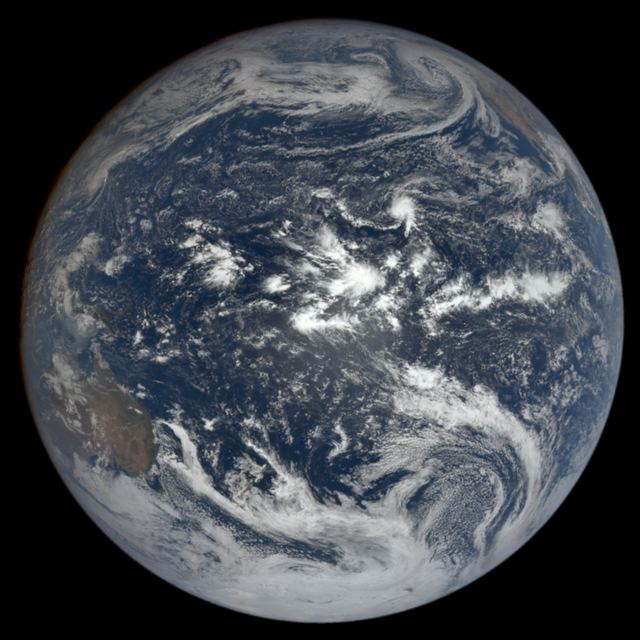
The whole sunlit side of Earth, taken by NASA's EPIC camera on the DSCOVR spacecraft, about 1.5 million km away. It was looking down on 9.3° S, 168.8° W. EPIC sends a new set every day or two, so this is its latest, not a live view.
See that day's images on NASA EPIC
NASA EPIC team, DSCOVR · Source
Last updated
The ISS right now
The station's position is worked out in your browser from its orbital elements.
Set your ZIP code on the radar to see when it next passes over you.
The International Space Station circles Earth about every 92 minutes, some 400 km up. You can see it with your eyes when it passes over in sunlight while your sky is dark: a steady, bright, moving light.
Orbital elements: CelesTrak · Source
Elements from
Space weather
Kp 0.3 now
39 solar flares in the last 3 days, the strongest M1.7. No geomagnetic storm (Kp at most 3 in 3 days): aurora unlikely outside the far north.
- Radio blackouts none
- Radiation storms none
- Geomagnetic storms none
Kp runs from 0 (calm) to 9 (an extreme storm); 5 and up is a geomagnetic storm. NOAA's scales run from 1 to 5.
NOAA Space Weather Prediction Center · Source
Updated
Asteroids this week
17 asteroids
pass within 7.5 million km of Earth in the 7 days from the update. The closest, 2026 VJ13, passes on at 837,409 mi (1,347,680 km), 3.5 times as far as the Moon. It is about 9 to 20 meters across, estimated from its brightness.
Close passes are normal: none of these is a threat.
NASA JPL Center for Near Earth Object Studies · Source
Updated
Earth events
40 natural events open in the last 30 days: 26 wildfires, 11 sea and lake ice, 3 severe storms.
- Wildfire Red Hill, Perry, MississippiWildfires ·
- Tropical Storm PenaSevere Storms ·
- Prescribed Fire Bienville CPT 29 Sub 2 RX, Scott, MississippiWildfires ·
- Typhoon CempakaSevere Storms ·
- Prescribed Fire Compartment 170 RX, Greene, GeorgiaWildfires ·
- Tropical Cyclone 03SSevere Storms ·
NASA EONET · Source
Updated
Data sources
- Earth from a million miles: NASA EPIC (the Earth Polychromatic Imaging Camera on DSCOVR), fetched with the site; a new set every day or two.
- The ISS right now: CelesTrak's orbital elements for the station, in the launch feed; your browser works out where it is and its next pass over your saved ZIP code (nothing is sent anywhere).
- Space weather: NOAA Space Weather Prediction Center: X ray flares, the Kp index and NOAA's scales; checked again by your browser while the page is open.
- Asteroids this week: NASA JPL's close approach data (CNEOS), fetched with the site.
- Earth events: NASA EONET: wildfires, storms, volcanoes and ice tracked by NASA and its partners; checked again by your browser while the page is open.
Astro Radar is not affiliated with NASA, NOAA or CelesTrak. NASA and NOAA data are public domain.